Does this solver know today’s answer?
No. It only uses the guesses and colors you enter. If you have not played a word, the solver cannot reveal it.

Type a number from 2 to 15. Classic Solver, Smart Guess Assistant, and Clue-Based Finder all use it. Changing it clears the current guesses.
Find the words that still fit your green, yellow, and gray feedback. This Wordle helper is a Wordle finder for the puzzle you are already playing: enter the guess, mark the colors, and the list narrows in your browser. That is the Wordle help on this page. It uses only the feedback you supply.
Loading the word lists…
…
The full answer list, before any feedback. Common words are listed first.
Loading the word lists…
Suggestions are calculated from the remaining answers. They are not guaranteed to solve the puzzle.
Loading the word lists…
The word lists are loading. This is not the official puzzle list, and it is not affiliated with The New York Times.
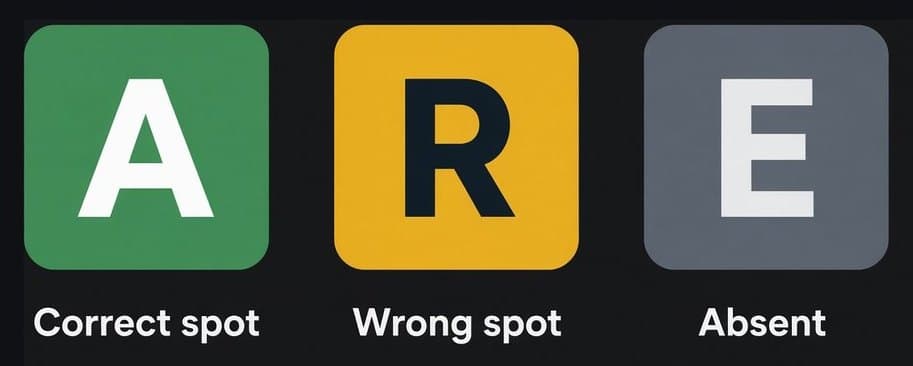
Each submitted row is stored as a word plus five marks. The engine does not treat those marks as loose rules that can drift apart. For every candidate, it plays your guess against that candidate with the standard two-pass Wordle check, then keeps the candidate only when the calculated pattern matches your row exactly. Later guesses are added to that test. They do not erase earlier rows.
The first pass marks exact letters green and counts the unused letters left in the candidate. The second pass marks a remaining copy yellow, or gray when no unused copy is left. That is what makes repeated letters safe. In ALLEY against APPLE, one L is yellow and the other is gray, because APPLE has only one L. A solver that treats every gray tile as “this letter is absent” would throw APPLE away.
Next guesses are ranked separately from the answer list. With many words left, the ranker prefers guesses that test letters common among those words. With a shorter list, it simulates each candidate guess, groups the answers by the color pattern they would produce, and prefers the guess that leaves fewer words on average. A possible answer gets a small tie-break, because guessing it can end the puzzle. None of these ranks is a promise. Two short guides go further: how repeated letters change the colors and how a next guess is chosen.
No. It only uses the guesses and colors you enter. If you have not played a word, the solver cannot reveal it.
No. It is an independent helper and is not affiliated with or endorsed by The New York Times. The dictionary is a common-English list, so it can differ from the list used by a particular puzzle.
That usually means a color was marked differently from the puzzle, or the answer is not in this dictionary. Change the tile colors and the list updates. The solver will not drop a constraint to invent a match.
No. Filtering and ranking run in your browser. The word lists are static files. The page does not create an account or store your puzzle.
A possible answer still fits every mark you entered. A recommended guess is a word that should divide those answers into smaller groups. It might not itself be a possible answer.
It is a solver, not a hidden-answer feed. You still play the puzzle, then record the green, yellow, and gray result. The page narrows the words that fit that result.